Showing posts with label adventure. Show all posts

Monday, 29 April 2019

Travels: Singapore


Arriving home felt strange. The weather was cold, the atmosphere felt lifeless and the buildings were drab. My body had adjusted itself to expect the immense heat, which slowed you down as you walked over baked concrete. But the audio-visuals of the places had seeped in to my subconscious and I wanted bright yellows and powder blues, decrepit old colonial style architecture and the sharp smell of fish sauce running down the drains. I missed the heat but not the mosquitoes, I pondered, scratching my scabs on the way home.


Day 1. 13/4/19
Singapore

We arrived in the early evening at Singapore Airport, to coincide with the opening of a new terminal called Jewel. It has the largest indoor waterfall in the world, or something, and we had no idea. The airport is firstly beautiful, a totally relaxing experience. Nice smells, tranquil lighting and soft furnishing, like a hotel lobby or a classy shopping mall. Rachel Chew (aka Papa Chew) was there – waiting for us – GRAND REUNION! I was excited to be in Sing and she was excited to see Jewel. We were both excited to see each other. Win win.

Rachel drove us to her home in Palm Avenue, which is also architecturally beautiful (a running theme.) The country is hot and humid, but also lush and amazing. No bugs, though tropical, a first! We met her mum MeiLing, who asked to be called Auntie and her dad Robert, whom yes, we should call Uncle. We were shown to our big room, had showers, then left to go eat chilli crab, a Singaporean delicacy. Thy drove us out to the East Coast area where we were right on the seafront. It was dark and I could see all the flashing lights from the buildings on the other side of the bay, but then Auntie corrected me, to tell me they were actually lights from the ships waiting to dock at Singapore’s port. So many ships.

JUMBO Chilli Crab restaurant was filled with families sitting round large circular tables, and when we arrived there was a long queue snaking past the entrance. The Chews had booked a table, of course, so we went upstairs and were presented with a royal feast: Prawns “drunk” in wine, salted egg (has the consistency of houmous and tastes like salty, rich, custard) lathered on crab, JUMBO chilli crab (delicious, sweet and spicy and everything a crab could be), tofu with veg, razor clams in garlic sauce with glass noodles, baby kai lan fried with garlic (Rachel’s favourite, a kind of succulent kale), lilac yam pudding topped with sweetcorn, mango and fresh fruits. Absolutely stuffed. There was also a cool “Tiger Auntie” – a waitress who goes around serving tables with Tiger beer in frosted glasses.

TJ joined us, which was lovely, Uncle Rob enjoyed talking about space programmes to Aidan, Darren came late as he had been spearfishing, so he was tired and felt like he had altitude sickness. Auntie kept ordering us more food and Rachel was a delight. It felt like I’d been adopted in to a Singaporean family.

Afterwards we left Auntie & Uncle and jumped in to taxi, which looked like a school bus. We headed downtown to the Ann Siang neighbourhood; weathered colonial shopfronts, narrow streets, colourfully lit up temples by night, to go to a bar called Native. It was in an interesting building, which used to be a storehouse for spices, then an opium den and now a hipster cocktail bar. Run by a fanatic who makes alcohol from anything sourced or inspired locally. My drink ‘Concrete Jungle’ had bee pollen sprinkled atop a single ice cube (the clearest block of ice I’ve ever seen.) The drink tasted fine. Aidan’s cocktail smelt of turmeric and tasted like sour curry. In London this would be pretentious, but in Singapore it somehow worked, probably because the barman was earnest, sincere and handsome, so I was 100% on board with the concept of Native.

Ashish joined us and his friend Miles, then we all walked towards China Town, down a touristic alley where all the ex-pats were hanging out. It sort of had the feeling of Spain, what with the heat, cobbled streets, neon signage, European architecture and white people. We went to a bar called Flagship where we drank beer and listened to indie music that played over the speakers, where we remained for the entire playlist, from Green Day to Green Day. Then left in the midnight heat, which I still found surprising, after TJ had sneakily and generously settled the bill for all of us.

Day 2. 14/4/19
Singapore

We did a lot today. Aquarium on Sentosa Island, lunch in Little India, Mustafa shopping mall, coffee at the National Gallery, the Asian Civilisations Museum (ACM) and TJ’s dinner.

It was a hot and slightly overcast day. Rachel took us to Sentosa Island and during the drive I couldn’t get over the futuristic skyline of central Singapore. It really is something. Better than any city skyline I’ve seen - better than Tokyo, NYC, London - because things are so new. And the designs of the skyscrapers are so stylish, coherent with the rest of the architecture, fitting compactly within the city. Also, it’s tropical so lush greenery, palm trees and bougainvillea swathe the sides of the immaculate roads.

The S.E.A. Aquarium tickets were bought for us by Darren (oh!), so we went inside and saw some amazing fish. But first, before that, here is some copy from the aquarium posters outside, which we all laughed about, primarily as Rachel and Aidan work in advertising:

“50% Cow 100% Fish” (with a picture of a cowfish)

“Less heart than a bad date” (with a picture of a jelly fish)

“Oh Crab! I’m that old” (with a picture of a crab)

In the shark tank we saw a Great White with its spectral eyes. There was a ginormous tank filled with grouper fish, sting rays and manta rays, gliding through the water like Star Wars spaceships. Darren knows a lot about fish (he designed and built his own fish pond which looks more like an aquarium), so it was pretty interesting to go with him. He commented that the yellow fin tuna inside the tank was unusual and probably wouldn’t survive long, because they’re an open water fish, adapted to travelling long distances in the ocean. ‘It’s rare for tuna fish to be bred in captivity, so I don’t know how they got one in here.’ Darren informed us that that whoever figures out how to farm tuna will be rich, as people have been trying and failing for years.

He seemed right about the Yellow Fin in the tank, it was the one fish swimming faster than the rest, darting in straight lines through the artificial waters. Zoom. It seemed aggravated and touchy and didn’t want to be contained or have to swerve to change directions. Each time the tuna got to the end of the tank, it would do a sharp U-turn and gun it straight to the other side, like doing lengths of a pool but with no goal in sight. Immense speed blocked by glass panes. The Yellow Fin would probably die exhausted by a lack of freedom.

There was a funny-looking fish called a Potato Cod with a fat snout, and the luminous sea jellies were fun, more like an art installation than an organism. The Moray Eel was highly impressive and looked like an underwater ancient god, with smaller eels worshipping at its rock opening. At the end of the aquarium we got given a bright blue and pink plush toy of an octopus, as they came free with our tickets. So, me and Chew found some children to donate our toys to and Aidan kept his for his little sister, who is an adult.


Chewy drove us to Little India next. Darren joined us for Indian food at Madras New Woodlands. We had dosa (with ghee is best), VIP dosa set, fake meat biriyani, and mango lassis all round. The whole area was different to the other ones we visited in Sing because it’s filled with Indian shops selling gold, saris, electronics, groceries, spices, etc. After lunch we went to Mustafa Shopping Mall where they sealed Aidan’s and Rachel’s bag with those plastic seal tags, to stop shoplifting, I guess. It was a bane because I had to cut it open to get my wallet out of Aidan’s bag when I bought a pair of Samsung headphones.

We all felt sleepy but decided to carry on rather than nap as ‘That would be a waste of our time in Singapore’, Aidan pointed out. Darren drove us to the National Gallery where he dropped us off, then an old white woman asked Aidan if he was an Uber driver. (>.<) Rachel wanted to take us for coffee at the National Gallery because of its grandeur, as it used to be the houses of parliament, so the re-purposed space is divine. High ceilings, cold marble floors, and the winner of the best children’s museum 2018. The coffee turned out to be iced Ceylon tea for both me and A; and even though Rachel constantly tries to pay for everything, we succeeded by buying the drinks this time. Score.

After sipping our iced beverages in Eames style chairs, we walked through and admired the building, then went outside to the civic town centre. We marched through the supreme courts, which is now the Victoria Theatre and viewed one of the two Raffles statues standing in the area. A member of the British East India Company who is acknowledged to be the founder of Singapore, yet we find out later at the ACM, he only spent an accumulative 9 months in the country and was more of a colonial propaganda figure than an active founder. We three considered the plaque on the Raffles statue in front of the Singapore River which reads:

On this historic site, Sir Stamford Raffles first landed in Singapore on 28th January 1819 and with genius and perception changed the destiny of Singapore from an obscure fishing village to a great seaport and modern metropolis.

As post-colonial theorists we found it a bit “off”. This year (2019) marks the bicentenary of Raffles’ colonisation, so Singapore has made an effort to tackle this off-ish plaque in the centre of their city, by putting up other statues, to encourage a dialogue between histories. A newly erected statue of Sang Nila Utama is now 100m away with its own plaque that reads:

Sang Nila Utama was a Srivijayan prince from Palembang, who arrived on our white sandy shores while on a hunt in 1299. His vision of a lion – which he took as a good omen – inspired him to establish the city of Singapura, the Lion City, which he and his descendants turned into a flourishing port.

This inscription is nowhere near as plucky or as punchy as the East India Co.’s, but it’s a start. At the Asian Civilisations Museum, we looked round the bicentennial Raffles exhibition, where an awesome curator-guide took us through his mostly Javanese collection, because that’s where Raffles was posted for the majority of his career. I found out at the time the E.I.C. had a bigger army than Britain and is considered to be the first global corporation in history. Damn. After viewing the wide array of artefacts at the ACM, including an almost complete Tang Dynasty shipwreck, TJ came to pick us up.

(Before TJ arrived, I tried a bite of Chewy’s durian flavoured ice cream and almost wretched. I learnt I hated durian, but I loved how the Singaporean ice-cream man sandwiched the ice-cream between a slice of white bread, so it's not cold on your teeth making it easier to eat.)

TJ’s mansion is in the jungle residential district of Singapore. It’s a massive house, beautifully kitted out with artefacts, dark wood furnishings and a swimming pool. TJ and his helpers had made us another feast, with lemon steamed fish, cuts of pork, glutinous rice, grilled chilli prawns and casual champagne. We were eating like aristocrats in Singapore. TJ’s dad joined us for dinner, who is quite the charmer and then later on in the evening, I had the honour of meeting his grandmother, who at 95 is looking sharp. Red lace fitted dress, heavy jade necklace, straight posture, bright eyes, narrow frame, pale skin. Graceful and eminent are the words I’ve found for her. Later on, I’m told she was one of the first female doctors of Singapore. Once dinner’s over and TJ’s family have hosted us admirably, we say our goodbyes and I really admire a Fauvist coloured ceramic statue of a Trojan Horse they have in their living room. That’s quite the gift.

Day 3. 15/4/19
Singapore

Rachel took Monday off work to show us around the city, which her mum was shocked about, ‘She works so hard, she says she can never take a day off.’ Rachel took us to the Botanic Gardens, which is free and easy to access. People can go there to enjoy the greenery, tropical indigenous forest and lake, or, in the cooler hours go jogging. I saw my first iguana! It was hunting for a worm or insect in the undergrowth, and it looked really intelligent, completely focussed on the task at hand of catching its prey. Smelling the ground with its forked tongue, then shovelling the dirt out of its way, and snapping up the creepy crawly with its jaws. Chewy tells us this is where she used to play Pokémon Go, ‘There’s great Grass Pokémon here’, but she gave up after she thought it was a waste of her life.

At the lake we saw many many turtles, including a mother and baby, gently flapping in the water by her side. They were mostly terrapins with the red slashes on their cheeks and were relaxing to watch. We also got introduced to The Kindness Lion at the park. A very basic design for a lion, like a cartoon character wearing sports kit, who encourages kind acts, ‘Like picking up litter’, among Singaporean school kids, Rachel tells us. I jokingly called him The Obedience Lion, but we posed for photos with him anyways.

Rachel then took us out for another amazing meal, this time to a Steamboat place called Hai Di Lao, where they have the best customer service. We arrived and they covered all your belongings with protective cloth, so they don’t get splashed by the sauces, and the waitress even took my glasses and sealed them in a plastic bag and placed them next to my seat. Neat. Steamboat is a Chinese dish where they cook all the meats and vegetables in a hot pot, sunken in to the table and bubbling with delicious stock. One half was spicy, and the other half was chicken stock. It’s a bit like fondue, but you can use the stock to make a clear soup for your noodles, also to combine and eat with other dishes. You cook your pork and beef cuts for different durations in the different pots, then pull them out with your chopsticks to dip in to various sauces. It was delicious. There was even a fresh noodle maker (like a mixologist but for noodles) who strung out, flicked and flipped fresh noodles at our table. It was pretty exciting, like a live noodle show. Later on, I saw the same noodle guy performing the tricks for a completely disinterested family who were looking down at their phones, and I felt sort of sad for him.

After the meal was over Rachel wanted to pay, but Aidan wanted to pay, so there was a hoo-haa. Even the staff got involved, but Chewy spoke to them in Mandarin and so, Aidan was thwarted in his efforts. Since we’d been out in the hot, outdoor humidity of the gardens and now we were full of Steamboat, we went home, showered and napped. Aidan had also been hit by a wave of jet lag. I fell asleep next to Chewy on her bed and dribbled on her mattress.

We woke up to find Rachel’s mum was offering to drive us to Gardens by the Bay, where the Supertrees are! I’d really wanted to see the Supertrees (mainly because of the Planet Earth BBC documentary) and it would be the perfect way to top off our stay. The Supertrees looked super cool up close; synthetic though abundant with nature, wild but clean, like Singapore.

Chew also got us entry tickets to the Cloud Dome and the Flower Dome, attached to the Supertrees complex. The Cloud Dome was impressive, like a modernised version of Kew Gardens, with an indoor waterfall and skywalk around a massive central pillar of plants. All the plants are from higher altitudes, so cooler climes. The lush vegetation gets misted with water for long periods of time forming clouds within the dome, making for good photo ops. It reminded me a bit of Laputa – Castle in the Sky.


There was a bird stuck inside, flying back and forth beneath the glass dome. Outside you could see the Singapore port really clearly, and again, the hundreds of container ships waiting to dock there. It looked unreal because I’ve never seen the sea look so congested. Singapore is a free port, so it attracts more ships as it has less trade restrictions than others.

We left the Cloud Dome and walked over to the main courtyard where we got our photos taken by a friendly and competent cameraman, a Dutch tourist on holiday with her family. Then we went to check the Flower Dome, which is less showy than the the other one, filled with flower beds and bushes. They were holding a tulip exhibition, so we got to walk through a mini Holland, with cut out windmills and fake verandas surrounded by beautiful tulips. There was a “European Market” going on inside the Flower Dome and it’s always interesting to see your own culture through another culture’s eyes, so we went in. It had stalls selling honey, wine, apple presse, popcorn and candy floss.

It was dusk so time for the Light Show! We headed back to the Supertrees where we sat on the ground with the amassing crowd and waited for it to begin. A big announcement said it was going to be ‘Retro Night’ tonight, then all these Sixties and Seventies tracks started playing up like The Jackson 5 and Tavares, and the Supertrees pulsated with disco lights to the music. Pop, funk, crowd-pleasers - though none of the crowd danced, which was odd. (They do this light show every night for FREE can you imagine how much energy must go in to putting on these light shows? If it’s not green energy, then does that negate the environmentally friendly impact the Supertrees are meant to be having? Just an afterthought.) I was having fun.


Once the light show was over, everyone pegged it over to Marina Bay Sands (MBS). That luxury hotel made famous to me by a Martin Solveig music video. The walk to MBS is stunning, the bridge has mood lighting with trees placed along the middle and it crosses a curve in the river, which is also tastefully lit. This whole area is re-claimed land (so that’s Singapore building in to the sea where there didn’t used to be anything there before), meaning that the city planning must have been an ideal vision realised. I can see that. The bridge becomes a mezzanine walkway, which runs over the hotel lobby, and then out again, to enter in to a luxury shopping mall - where there’s an artificial river running under the shops with gondolas for hire. I mean, come on. There’s an indoor waterfall in this mall too, which is chock-a-block full of brands that I can’t afford: Gucci, Chanel, Hermes. We exit again in to the Marina where there is a hideously dramatic laser show going on.

Fountains of water shoot up in to the air! Green laser beams splice through cascades of water, as music from the last fight scene in LOTR (or something like it) blares over the loudspeakers. People are transfixed and it is the most tasteless and intense splashing I have ever seen. It ends by people clapping but also stampeding away from the Marina, which is actually quite pretty when there aren’t any laser beams in the way.

We decided to go to the rooftop bar on top of MBS, so that Aidan could finally get a chance to buy Rachel a drink, also to get a stunning view of the city by night. We even got a good table to perch on and discussed what that dark patch could be in the middle of the city? (We zoomed in on google maps and it turned out to be the National Zoo.) Drinks followed by Malay food, followed by beer at Haji Lane, where there was live music being played by different guitar singer/songwriters, all positioned equidistantly apart down the street.

Haji Lane used to be cool back in the day, actually Auntie told us she used to go hang out there when she was younger, but alas no more. Its hippy heritage is reflected only in the psychedelic street art, whose purpose today seemed primarily commercial. We sat outside a bar called Blujaz Café, where Chew had a gin & tonic as she was working the next day and me and A shared a jug of beer. I noted how Singapore must be so safe because a woman nearby left her handbag in plain sight on her bar table, while she went for a smoke around the corner, which would be crazy in London.

We’d had a really good time in Singapore, but sadly our time was up. Chew who had looked after us so well, took us home in a taxi, then said goodnight. She saw us off in the morning when we went to catch a bus for Malaysia.


Monday, 29 May 2017

Nakasendo


I waved goodbye to my boyfriend through the train window and made my way back to Obaachan’s. It was a Sunday, so I shared the carriage ride home with all the drunken sleepers retracing their steps on the first train creeping in to the suburbs, the dusty velvet green cushions smelt of stale smoke and cocktails, whilst I dreamt about the mountains.

1
Yagisaki Station – Yokokawa – Karuizawa

Hiking shoes on, rucksack strapped, walking stick bought. We’re on our way in to the countryside for a five day hike in the Kiso Valleys, following the Nakasendo Trail, an old Edo trade route linking Kyoto and Tokyo (which used to be called Edo). Doing the whole trail would be impossible in the time frame and with my short legs, but we can walk a fair stretch of it and take in the beautiful historical scenery. Aidan planned the route superbly with train rides to break up our long walks, so I’m hopeful that I won’t drag down his pace or morale if I get tired and hungry.

Yokokawa station is at the foot of some big mountains and when we arrive there is a cold drizzling mist blanketing the earth. I look around and it feels like we’ve come to a nowhere town. The mist tastes great. My aunt Mariko told me the night before we left on the trip that Yokokawa is famous for their kama meshi; a ceramic bowl filled with warm rice and delicious things that travellers ate on their way. A bento bowl. I had that on my mind as we disembarked the train but we were too early as none of the shop fronts were open, and so, we two ventured out in to the mist like the brave explorers we were. Halfway down the long road we realised that we were going the wrong way. So we turned around and trundled back up the road and here my co-pilot and I learned our first lesson of hiking holidays: Setting off in the right direction is the first and most important hurdle. On the bright side, when we returned to Yokokawa station the shops were open and serving kama meshi. Yay! We bought two solid pots that were radiating heat, and I stuffed them in to the top of my rucksack.

On the road again, walking by the side of a winding highway for the first part, until it got quieter and we passed a shrine at the foot of the mountains with no discernible name. I’m always up for visiting shrines/temples when we come across them on the way, so we climb the steps and have a look. A plateau clearing amidst a dense dark forest with a wide wooden shrine standing at the back. It seemed forgotten, tranquil and held a subdued awesomeness - just the kind of shrine I like. I shook the bell, made a racket and did omairi (showed some respect) then we headed on our way. Sometime soon after we see a thin wooden post with a sign that reads:

中山道
Nakasendo

It looked very unassuming so we doubted it for a second, but as we’ll find out over the course of our trip not that many people do this walk. And the truck drivers will wonder when they pass us on highways whether we’re mad or foreign, or both. But yes, here it was the first sign of the old road! It led us under a newly constructed tunnel and then up a steep hillside to a shelter. In the shelter were an old Japanese couple who looked like true hikers, so I knew we were in the right place. To the left of them was a small dark path that led upwards in to a thick forest and mountains and then disappeared. The initial clamber was steep and sweaty, and as we rose above the road we’d left behind, the mist caught between the trees and dissipated a green glow around my ankles. At least it wasn’t hot or humid but cool and wet. I used Piston (the name I gave my walking stick) to haul me up the mountain, whilst Aidan strode out in front, bounding off boulders and I felt very heavy. There were small stone markers along the steep track, and we passed an Australian group of hikers who chirruped some friendly comments, which I can’t remember because I was concentrating on moving my feet. Already feeling so tired I wasn’t sure if I could actually keep this up for five days, but not listening to my brain, I carried on struggling up rocks. At the steepest point we passed a huge pile of stones that previous passers-by had accumulated on top of each other, which I guess was a form of encouragement. But I was still out of breath and feeling dizzy so I said I really want to - eat – lunch - please? My kind co-pilot told me that we were scaling a mountain, so, I shouldn’t feel too bad about being tired already and at the next carved out hollow on the mountainside we opened up our kama meshi, still warm in the pot. I’m not going to lie, lunch was my favourite part of the first day. It held inside the best meal I could have wished for. A cute egg, mushrooms, sweet ginger, apricot, pickled plum, bamboo shoots, pork, chicken, and a chestnut all on a bed of white rice. After chomping down the meal and a good glug of water I felt ready to climb mountains again.

The rain had stopped but thankfully the cooling white mist was still present, and once we had cleared the steep rubble path we entered a surreal dreamlike forest. The tree trunks shot up in to the canopy like telegraph poles, and the earth beneath my feet was bouncy. Good for treading. The green leaves above and the foliage all around produced a matcha mist to walk through, whilst in the distance you could make out a smokey blue horizon. When you stopped all you could hear were raindrops far above, dripping on leaves upon leaves. Bird song and silence. The walk had become satisfying and Piston was doing a good job of holding me up. Eating the lunches had lightened my load and the whole thing seemed magical now, and comparatively easy. We pass a stone Buddha on a lotus leaf encased in a green thicket. There are a multitude of  おじぞうさん or jizo we pass along the path, protectors of travellers and markers for the old Nakasendo road. Inconspicuous stone saints with bald bowed heads, whom I want to give a nod of appreciation to every time I notice one. We press through a high peak between the mountain, splitting the North and the South side, and when we reach the “middle” of the way there is a tumbledown teahouse, well abandoned with smashed panes of glass and sagging roof. Quite surprisingly looming in the mist high above us is a long-forgotten hotel. A ruin and a relic from the Bubble Era, with a skeleton of a bus precariously driven to the end of the road and parked there for the rest of time, beside this eerie collapsing building. I thought about the last hotelier who must have closed-up shop, turning his back on that strange mountain life of luxury and loneliness.

Four hours in to our six hour walk is when you’re feeling grateful for the escape that the mountains provide. No people, no talking, just trees. But then I feel a little sad that I’ll be leaving this mountain behind, even if I did struggle at the beginning - that this soon will pass.

We reach Kumano Jinja near the summit of Mount Asama, which has two shrines and a very old bell and tree, both as holy. Cutting through Kumano Jinja is the border of two neighbouring prefectures of Nagano and Gunma, so I guess we were in both at the same time. There is a spectacular view over the mountain ranges from the precincts of the shrine but due to the mist we saw nothing. But we ate a Calorie Mate snack bar (the maple flavour is the best) and imagined the view we could see through the freezing fog, and took it all in. We only had to walk down a proper road made for vehicles and we would soon be in Karuizawa town. Instead of following this boring road we took a winding trail that led us through woodland, betwixt the second-homes for the famous and wealthy. Odd modernist shapes stuck out from the fertile ground, one had an indoor swimming pool and others looked like the Sylvanian Families house. The hiking trail shot us out in to Karuizawa Ginza, a classy boulevard of designer shops and bakeries. A funny spot to see us in after hours of sweaty trekking. We walk through this rejuvenated Edo post-town of Karuizawa, a resort-town now for tourists and a hang-out for moneyed families, and keep on walking to our out of the way motel.

2
Karuizawa Station – Kiso Hirasawa – Narai juku

We are now chasing the sun riding on a tetsudo train called the Shinano WanMan ンマン* It's very exciting because we’re chugging along over the railway tracks and I love old trains. Mountains appear broken up by towns and sometimes I get a glimpse of river. After yesterday’s long and arduous walk I’m glad to be plonked down on a train seat, eating gummy sweets and looking out over fast-paced scenery. The train ride takes approximately three hours, with a transfer break on a station platform where we share an Ebisu beer. The mountain range we left behind in Karuizawa looked like it was about to be engulfed in swathes of rain, so good riddance, because here we are on our sunny platform drinking a beer. My sun hat from Okinawa is being used for the first time after a soggy start.

*Until recently I thought it was called a ManMan train, but when I visited my friend Moe in Kyoto we rode on a similar kind of train driven by one conductor aka. one man aka. WanMan - even thought it was a woman - so now I know what the train is correctly called and why.

The train drops us off at Kiso Hirasawa Station, where no one else gets off and it’s a clear blue sky day. The JR ticket office attendant did her best to hide her wonder when I asked how much a ticket cost to this place, and the lack of trains presumably attests to how unpopular this post-town is with tourists. Kiso Hirasawa is famous for lacquer ware, because in the Edo Period the profitable post-towns along the Nakasendo had to diversify to make their income after the Shogun made it illegal to sell off their timber. The Kiso Valley has lots of forest and good sources of cypress, which the Shogun zealously controlled and taxed. Walking through Kiso Hirasawa there are lots of lacquer ware shop fronts, beautifully embellished with Edo period architecture but for some reason all the shops are closed. It is a dead zone. With the lack of people and the old wooden roofs however, swallows swoop in and out darting every which way, tinged with cobalt blue and red cheeks. Enjoying the sun we walked around this pretty post-town twice, swinging by the main Hachiman shrine at the end of town. On the second time round we passed a pickle van and man, who had parked up beside two old obaachans in the street. I asked them Why were the shops all closed? and one says because Nothing happens and if we were looking for somewhere more interesting then we should try Narai, the next town. That’s lucky because we’re staying there tonight, I think and buy a packet of dried apricots from the pickle man. But the two old ladies are perfectly happy basking in the sun with their pickles.

Following a well-trodden path beside a river we head toward Narai juku. Juku I find out simply means post-town, so a lot of the towns along the Nakasendo have this adage as they were built for the purpose of serving runners and riders along the mountain way. There are five main historical trails in Japan: Tokaido, Nikko-Kaido, Nakasendo, Mito-Kaido, Koushu-Kaido. And they all linked cities to Tokyo in the feudal times but are now out of use because we have cars and aeroplanes. The trail we’re taking is called the Nakasendo, also known as the Princess Road, because a famous princess from Kyoto once travelled across it to reach Edo after she got married. The Nakasendo was better suited for women and their entourage plus all their belongings and dowry, because the trail does not cross any rivers, which the speedier Tokaido passage would have encountered. I imagine, getting expensive silks wet or drowning men for a cedar closet wasn’t a risk a daimyo was willing to take when it came to his wife. But it must have been knackering for all those carriers and commoners (many probably died) to help move important possessions along this narrow and steep path, bravo feudal barrow boys.

Reaching Narai juku by foot is a sight. The exquisite Edo period features remain on the minshuku & ryokans (inns) and shops lining the main road; the upper half of the buildings jut out slightly over the lower half, giving the street a lean-to feeling of antiquity and bygone bustle. We reach Narai in the late afternoon sun. Western tourists are wondering the street admiring the wooden frames and swooping swallows, and I discern the figure of a busy innkeeper wiping down the back of a frosted glass door. Not quite sure where we are staying but knowing that it is in this idyllic postcard post-town makes me excited and nervous, but as we look at the street map with all the names of the minshuku and find ours, we walk on as a green-blue mountain steadily rises over the road in the distance. We find it with a wooden sliding door and a small lamp outside, which has a blue and white stencil of a crescent moon and two stars; Tsuchikawa Ryokan is a blessing. Going through a long corridor and up the stairs in to an old Japanese house, we’re met by an angelic woman who feels like a mother. She lets us take off our muddy shoes, and shows us the way to the top floor, to our spacious room, then gently leaves us. The view from our tatami is breathtaking. Mountains upon mountains and sky. Later at dinner she tells me that we are 934m above sea level, so tomorrow our walk up to Tori Toge Pass won’t be too difficult as we’ll only have to ascend another 100m, or so. The air is pure and the stars are bright. And we have a wooden bath tub to soak in, and there’s only one other guest whom we don’t see until breakfast, who turns out to be a lacquer ware specialist out on fieldwork. This place is a mysterious precious stone you should hold on to but not stare at, keeping it safe in your pocket. A writer wrote about the room we’re staying in at Tsuchikawa Inn and we flicked through his book in the evening, but as we’ve noticed when the sun starts to set in the mountains, it gets dark fast so we turn in to sleep early and wake up with the dawn.

3
Narai juku – Tori Toge Pass –Yabuhara – Route 19 - Miyanokoshi – Kiso Fukushima

Today was the first hot day. As we left the minshuku of dreams the innkeeper gave us two sweets, which I sucked on all the way up the steep mountain path made of rubble, Piston again helping me to survive. The song of the uguisu also kept me going, that Japanese bird of springtime, as beads of sweat rolled into my eyes and made them sting. Aidan was in shorts and climbing heroically, along the trail we passed a few points where fresh cool drinking water could be caught and drunk straight from the mountains in two blue ceramic cups left there by some lovely person. The town of Narai juku we left behind was the real deal, with 200 stone jizo statues and graves for ancestors carved in to the steep mountainside overlooking the town. As we climbed, I thought what a relief it would have been for travellers making the descent to end up in that thriving civilised post-town, but sadly we were going the other direction. There was a respite at the end of all of this clambering, which turned out to be this Big View of mountains Far Away and a feeling of accomplishment. I took a long drink of water whilst Aidan drenched his cap in a clean spring and slopped it back on top of his hot head. He’d adopted a walking stick on the way up, one that had been left behind by previous ramblers, and named it Magnus.

The Tori Toge Pass should be somewhere around here - but neither of us knew what it looked like or what it was, so we walked around in circles at the top of this Big View for almost an hour, getting lost and ending up at a maintenance facility point for an electrical satellite. We finally decided that the Tori Toge Pass was this crossroads that we’d walked over several times now, and we were right, it’s an ancient checkpoint for guardsmen who had been off duty for about 400 years. We took a wide gravel path that descended down the other side of the valley, nowhere near Narai anymore and ambled happily under the shade of the tall trees heading towards the next post-town called Yabuhara juku. The Nakasendo trail led us out on to hot tarmac and no shade in the midday sun, so we walked through this quiet town until we spotted the railway. Positioned on a peak next to Yabuhara Station was a shrine, so we climbed up to see it, and we sat down on the cool damp earth and looked over the town, deciding whether to take a train or not, and more importantly where to have lunch. We found Oginoya soba restaurant, where the pugnacious dedicated chef provided us with refreshing zaru soba seasoned with ginger and ume, a tart plum sauce. In the dark interior of this renovated old Japanese house where we ate the noodles, there was a Colorado family who were loving the mountains, and walking the Nakasendo in the opposite way. We’re heading towards Kyoto, and they’re heading towards Tokyo, and from what they said it sounded like we had a lot of interesting post-towns to come. The head chef owner gave me thorough advice in rapid fire Japanese about what we should do next. The train wasn’t leaving Yabuhara Station for over an hour so we should carry on to the next post-town called Miyanokoshi, and get the train from there to our end destination. OK I said, and he warned us there was a strip of motorway on Route 19, but it wouldn’t be too bad, so that’s what we did.

Leaving Yabuhara there is a preserved steam locomotive with flowers growing up and through its spokes, and a farmer couple planting down rice saplings in neat straight lines. The paddy fields where Obaachan lives have been seeded for a while now, so they must plant later in the mountains, as it’s cooler in the higher altitude. The temperatures in the morning and afternoon differ by ten degrees or more, and it gets really hot around 2-3PM. We’ve come in a good season when it’s not raining or blistering, although it feels like it as we walk hugging the highway, buffeted by hot gusts of wind from cars and lorry exhausts. After one ugly mural and my asphalt based nose runs, we reach this calm divergence off the highway crossing the river. I stop in the well-needed shade and chew up all the apricots I bought from the pickle man, then Aidan spots a little vermillion snake swimming avidly upstream and not making it very far. Entranced by the slippery snake I slap on more sunscreen over layers of old sunscreen, and we head on south through the valley. Suddenly there’s a snow-peaked mountain far off in the distance (probably Mt. Kyogatake) and we break out in to the open, amongst placid sun-baked paddy fields. Luckily we took the scenic route avoiding a causeway tunnel we can hear thundering off in the distance, but I spoke too fast, because coming up is the highway again and jesus we have to walk through a tunnel. Murderous vans roll past perilously close I feel, but there’s a raised pavement so I guess we’re safe. Echoes like rumbling thunder strike every time a truck goes through the entrance or exits, and it feels like we’re getting close to Mordor.

Out on the other side there’s a Seven Eleven where we rest for half an hour sipping on cold sweet coffees, dusting ourselves off, and making the most of the free wifi. There’s still a leg to go before we arrive at Miyanokoshi Station, but on the way we pass a great deep lagoon where a dragon who disguised itself as a princess is said to be sleeping. Peering over the edge in to the dark turquoise waters we encounter a boy of about three or six who thinks I’m an obaachan (a very old woman) because of my attire (towel draped over my head under a sun hat), and he explains to us that if his Obaachan fell down the abyss then she would turn in to bones. Yes that’s true. We walk on. To reach the station we pass through a hamlet and fields being irrigated by gurgling sparkling water, storehouses filled with timber and made of the stuff, a few people walking their dogs and finally here we are in Miyanokoshi juku. There is a museum here dedicated to a samurai family with a well kempt garden, but we don’t have time to investigate it because there’s less than one train per hour and it’s almost time. We hurry on through the sleepy post-town and enter the station where there’s not a soul in sight apart from a cleaner who is mopping the stairs. I ask her How do we get to Kiso Fukushima Station? And she gives me a toothy grin and tells me to Cross the bridge over to the other platform then wait exactly in that white square. When you get on the train you take a coupon then pay for a ticket. We collapse in a heap on the other platform gulping lots of water, knowing we probably hadn’t drunk enough. My face is all red and dirty from the road, and Aidan is sprawled in the shade. The small train comes on time and we board feeling like the muckiest passengers alive, and the cleaner with her mop boards with us; she tells me, I live in Fukushima. I come here every day and clean that platform and by the time I’ve finished cleaning the other platform my train pulls up. I do it every day. It’s my job. That sounds like a nice routine I think, and nod to show her my appreciation, then the brilliant landscape of the Kiso Valley opens up and flits past us through the carriage windows.

Off the train at a neighbouring major post-town called Kiso Fukushima juku we pop in to the tourist bureau to ask for directions to our hotel. It’s on the other side of town but we get to walk beside the Kiso River to get there; the sun is setting as we venture through the most urban place we’ve visited yet. Wearily treading over the pavement that skirts along the foot of the impressive Mt. Ontake, we pass a crowded graveyard full of ancestors cut deep in to the hillside looking over the town, the remains of a chapel, and lots more jizo. It’s the time when school ends, so we pass a lot of children in yellow caps carrying randoseru bags, and as we pass each child Aidan gives them a hearty greeting like he does with every other walker we pass on our travels. One cheeky kid mimics his foreign accented Konnichiwa! leaving me laughing. We stay in Kiso Mikawaya that night which has an onsen (hot spring) in the basement and a view over the Kiso River. It’s beautiful at dusk, but I’ve got a primal fear of the raging river outside in the darkness and Aidan’s eyes are red from an allergic reaction to the sun cream, but I feel like a queen to not be wearing walking boots.

4
Kiso Fukushima Station – Nojiri – Junikane – Route 19 / Kiso Valley - Midono – Wago – Godo – Watashima – Tsumago – O-Tsumago

A big day of walking ahead so we get an early train out of Kiso Fukushima. It was a nice town with historic sites and a visible population that made it tick to a modern clock. Many people spend a day hiking around Mt. Ontake, which is a spiritual spot for healers and good for creative inspiration. And passing through the town I saw a road sign that read like poetry:

Please drive slowly
Swallows are flying lowly

So I liked the place. It was a shame we didn’t have more time to explore it but we were on a tight walker’s schedule, you know how it is. When we got to the station half an hour early for the train it was crucial to stock up on food before it came, otherwise we’d have to do a whole day’s hike with no provisions apart from those dry Nature Valley bars, which no one fancied. Some guy who looked like a tech start-up founder walked over to us and started talking in English, with confidence, which is a rare and brilliant effort from a Japanese native. And we asked him and his lovely wife standing there beside him Dyu know if there’s a supermarket nearby? And he said Sure, we need to go anyway, I’ll take you. And with that we followed him not down the road but in to his car and he drove us at a pace to the nearest convenience store, then drove us back in time to catch our train! What a top bloke. His name is Naoki and he loves walking too, he’s even done that 88 shrine pilgrimage around the Japanese islands and now lives near the mountains to live out his hobby. Hi-five for Naoki. With a swift goodbye and plastic bag full of onigiri, sweets, and drinks we boarded the train that would take us to Nojiri.

From Nojiri Station the plan was to walk through mountain paths to miss out a highway and then drop down somewhere in the remote valleys, but alas, we walked up into woodland and then got lost down a logging track and had to retrace our steps. It was hot but early, so, undeterred we found another track that looked promising, which led us through a tori gate towards a shrine that looked undiscovered or wholly attended by spirits, but we figured that we were still lost however mysterious and pretty this all was, so we left that place. We returned to Nojiri juku and walked through this peaceful village following its main road that had been built with sharp right angles to deter attackers. It may not be exactly here - but it’s in the area anyway so it’s worth mentioning - in the near distant past a samurai came through the Kiso Valley and was asked by a small village to help them fight off the raiding bandits. The samurai agreed and won the battle for the village but lost his life in the fight, and this inspired Akira Kurosawa’s film Seven Samurai. Neat. We were soon in the neighbouring post-town of Junikane, a sleepy hamlet and one of my favourites because all the inhabitants owned Shiba-ken dogs. They look like foxes with a smile and they’re keen-eyed without being nosy. As we turned a bend the whole verdant valley opened up before us and we were greeted by a rounded-back obaachan in the fields, and a friendly peaceable natured Shiba pup who loved to be petted. Junikane is comprised of a few houses and shrines, so we sat in the main shrine precinct and ate an onigiri before deciding to press on.

Down below us we could see a railway track, which meant we were by Junikane Station. I had a look at the train timetable and there was no train for over an hour so we walked on as planned, and were soon joined by a bunch of healthy-looking old people, all possibly embarking on a group walking tour. It meant we had company for perhaps the first time on our holiday, and it gave us confidence that we were indeed walking in the right direction. An old couple in matching bucket hats leads the way. Hurray. We walked beside the Kiso River, sandwiched between stunning scenery and a busy highway (Route 19 that’s built on top of the old Nakasendo road), moved along by the calming presence of pensioners. The enormous boulders on the riverbed, cracked and bleached bone white by the sun looked immovable; but the ice-water melt off the mountains and the litres of rain during typhoons gushing in to the river, means they must be have been budged. It was scorching hot and my eyes were dry even though I was downing lots of water, all thanks to my over-active sweat glands. When the single file of oldies in front started to cross the highway, one by one, and we followed I was pleased. Then when we got into some shade and felt a cool breeze I was joyful. Aidan bought me a can of cold drink from the vending machine and I stripped off in to my bra and wiped down my sweat, and did a little dance under the shade of a tree. Free from the straps of my rucksack! We were now in Midono juku where there’s also a station, but we’d made it through the toughest leg on the motorway, so after my breather, I was happy to carry on going.

Early afternoon in the mountains is hot and the shade from bamboo groves is a solace. We pass through a post-town named Wago, I think famed for their sake because another post-town was prohibited from making any. Then Godo, which I like because of its name that sounds like my favourite play. We take a break in the shade of a monument erected for a particular professor. Whenever we find running water, Aidan douses his cap and slaps it on to his head to cool down, whilst I continue to wear my obaachan attire with the hand-towel draped over my head and under my hat. Caked in sun cream and sweat. The gardens of the residences in this area are super well cared for, pruned and preened to perfection, not a pine needle out of place. There is a breezy cobbled path that leads us through bamboo and I laugh at how idyllic it is here. It’s as hot as a summer’s day and we spot two small kids, a brother and his younger sister, being sprayed down by a hose by their dad. He’s cleaning out their coy carp pond and the little girl comes to show me, there’s a round plastic pool brimming with water holding gold and orange fish. Her brother looks like the boss because he’s got a fishing net, casually slung over his shoulders like the barrel of a gun. You know we’re almost where we want to be? And that’s Tsumago: The Postcard Post-Town of the Nakasendo.

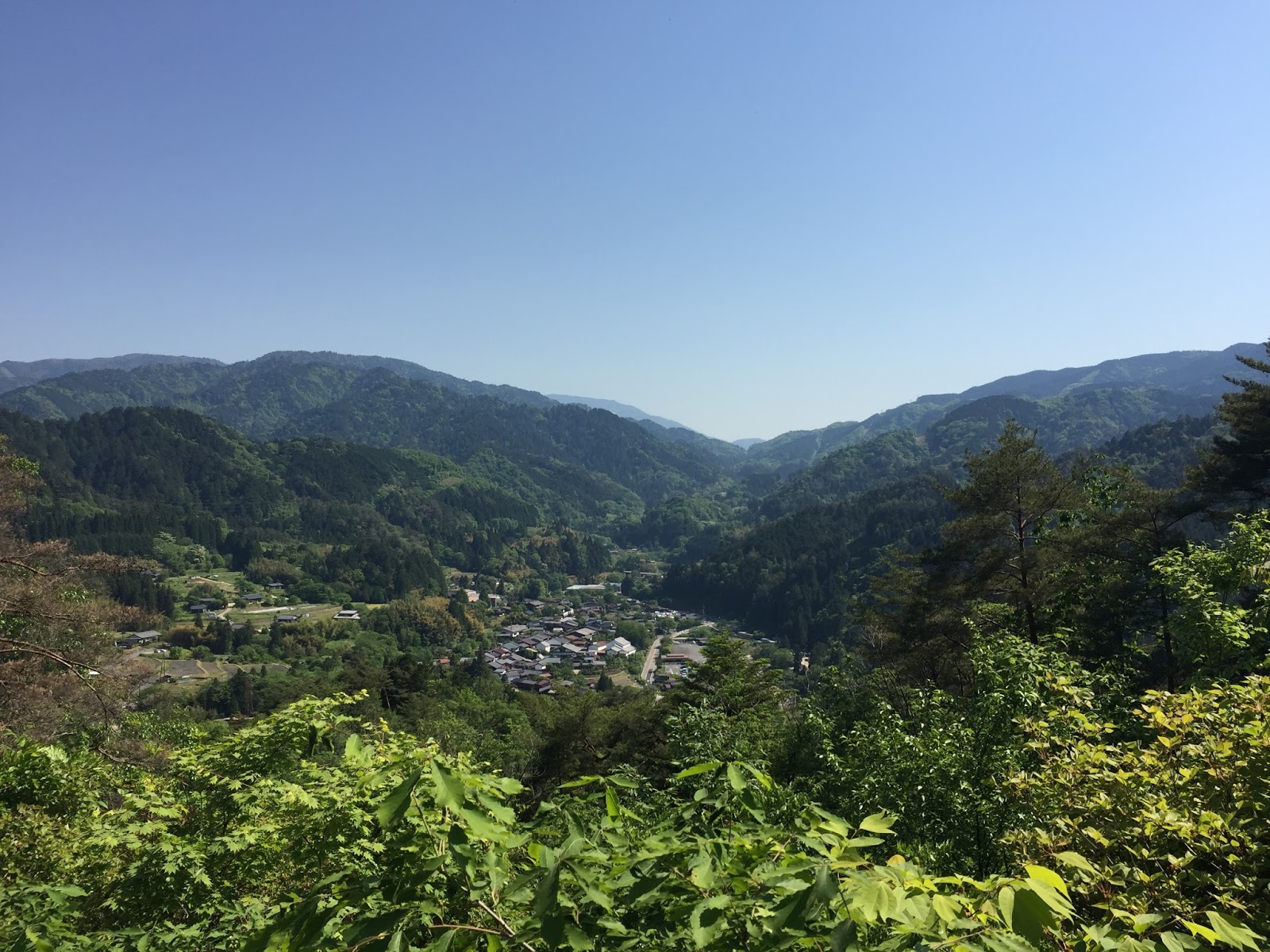
Before we reach Tsumago juku we climb yet another steep mountain path - because why not - that leads us to the ruins of Tsumago Castle. It curves through dense forest to a clearing on a mountain top where the castle used to stand. From here we can look down in to the valley and see the straight long narrow street of Tsumago in front, which is famed for it’s Edo Period authenticity, thanks to a ban on overhead wires and vending machines. The view makes it feel like an accomplishment and I stretch out my un-baggaged arms to the stratosphere. My shoulders are going to ache tomorrow but it’ll be the last day, so I’d better make the most of it. Piston helps me down the ridge and we take the final part of our route that leads us straight in to Tsumago juku. I’ve become accustomed to our solitude and so find it alien to encounter the multitude of clean tourists in town, especially anyone who looks fashionable, they’re an exotic bird to me at this point. First thing we do is grab an ice cold beer in the garden of a tea place. Yes. There’s a small dark pond with brightly coloured coy darting through it, and we sit and drink and cool off.

Walking down the street of Tsumago there are museums and souvenir shops, you can buy geta (old wooden sandals) and I overhear a shopkeeper showing off that he once killed a black bear There’s his skin, hanging right there! Our post-town experiences have all been of a similar shade but this place feels like a living museum with no town’s people living here, perhaps they run the shops and commute in. At night when we come back to walk the streets, it is dead quiet and we stumble across a few other tourists taking night time photos, and one cat. Our minshuku for the evening is located at O-Tsumago, which is an off-shoot post-town a few kilometres away, so we amble slowly through the historical settings to reach it in time for tea. The croak of the frogs in the night time, a million horns and trumpets rising out of the rice paddies, sounds like a hilarious orchestra, drowning out the sounds of the trees and rivers.

5
O-Tsumago – Magome

We stayed the night in a cheerful inn called Hanaya Ryokan, where the innkeepers had a family of their own, four or five boys and a girl. We encountered a little one in the corridor who showed us his grazed palm, and I was witness to another one’s meltdown when he found out the bath wasn’t ready. The whole family looked picturesque in the fading light of the evening playing with fireworks by the river.

After breakfast we set off in to the mountains to walk the most popular part of the Nakasendo Trail, between Tsumago and Magome juku. You pass two waterfalls on the way, the male waterfall Otaki and the female waterfall Metaki. We posed according to gender in front of those watery wonders. At some point on this trail is a tea house run by an old man dressed in a jinbei. He serves tea for guests and walkers and keeps a record of everyone who passes through and their nationality. Yesterday: 124 people. Canadian, Spanish, Australian, French, Mexican, Taiwanese, Dutch. Friday: 108 people. American, English, Brzailian, Finnish, Chinese, German. His eyes light up when I ask him about the traditional hearth he’s prepared, and why there’s always a model of fish hanging on top of iron kettles? The fish is a water creature and the kettle is of fire, so the fish will work to keep the fire below its line to protect the rest of the house from catching fire. He chops wood blocks with an axe and serves us tea. The phone rings and a fire announcement for the mountains crackles over the loudspeaker. We bow and place some coins in the donation box to get on our way to Magome, but afterwards I’m still thinking about what he said, in the few moments of dark quiet we stole in the smokey shade of his world. In that old museum piece of a Japanese house on the Nakasendo. He is interested in telling people about the original walkers of the Nakasendo, commoners who had to carry loads, run to feed families, sell wares to make money. They stopped along the way at havens like the place he’s housekeeping, slurping noodles, drinking water, sharing stories. Today he is the only volunteer working 360 days a year to keep that place running - I get five days off for New Year.


We pass a famous twinned cypress tree; two trees that grew in to one. And for the final memorable time on our hike we pass a group of stone jizo, or saints marking the way. I have loved how the sunlight dapples the forest floor and the sheer amount of green I have grown used to seeing every day. The path leads us out of the mountains and onto a road that winds steadily downwards towards Magome juku. There’s a viewpoint from where we can see several mountains under the searing sun, and it feels like we’ve done something. Magome is another touristic post-town, not too dissimilar from Tsumago, hence maybe why they’re linked together in the guidebooks. There’s a general hustle and bustle but because it’s 28 degrees and rising, everyone is melting (or maybe only me) so we duck in to a soba shop and order noodles and beer. We’ve got a bus to catch out of the mountains back in to the city of Nagano, then a bullet train to hurtle us back towards Tokyo, undoing all the beautiful labour of the last five days. And we’re happy.