Showing posts with label hiking. Show all posts

Wednesday, 22 May 2019

Travels: Malaysia (Part 2)


Day 6. 18/4/19
Kuala Lumpur

Today was an early start as we were moving out of Melaka to Kuala Lumpur. Got up at 7:30am to have breakfast at a small Chinese-Malay restaurant by the side of the road near our hostel. The menu was limited and I didn’t know what anything was, so the woman who worked there gave us bowls of soup made of sweet soy stock containing lean pork meat and tofu. It was sweet, salty and tasted home-made. Freshly chopped chilli in soy sauce was dribbled on to a tiny plate to dip the pork in to. At Omni Hostel for the last time, we waited for a driver named Izad who never showed up, so we decided to get ourselves to Melaka Sentral to take a two hour coach ride to KL, no biggy.

While waiting for Izad I met a San-Franciscan who had been travelling for a few months and had ended up in Melaka. Her name was Linda, she had been adopted by her American parents as a baby from Vietnam, and now she was on a journey to find herself; her roots; her identity. She’d spent three months in Vietnam travelling solo until her tourist visa ran out, she couldn’t speak the language and didn’t know anyone – quite the bold move. I asked her whether she had taken a sabbatical from work. ‘No. I quit my job, I sold my house. I’m going to travel until my budget runs out, basically.’

Travelling in an air-conditioned box on wheels to Kuala Lumpur, I saw how the city enveloped us and was ginormous. The drop-off point was TBS (the central bus station) and as we were trying to figure out how to get to the main station, a ticket inspector-cum-railway official scooped us up. He gave us a colour photocopy of a metro map and took us to a balcony overlooking three railway tracks. It was still hot in the city, although of a different kind, an oppressive heat where there was no breeze, but you could get blasted by air-con every time you passed a sliding door. Pointing at the tracks he said, ‘This one is fast train to airport. This is slight-ly slower train. This takes you to KL Sentral, you want to take this.’

We headed across the concourse where people were busking, begging and selling fruit. The trains are of course, highly air-conditioned and riding in to KL for the first time was undoubtedly cool. It’s a real metropolis and seeing the Petronas Towers glinting in the sun was awesome. The Petronas Towers are Islamic architecture inspired skyscrapers, hence the shape of their spikes that look like minarets crafted in platinum shiny steel. The taxi from the station sped us around a busy and congested city – skyscrapers, causeways, not pedestrianised.

The place we were staying at was funnily enough called Platinum Face Suites, which was a hyper-modern tower block that was also a 5-star luxury hotel (I still don’t get the AirBnB set-up, it was likely dodgy, so best not question it) which came with an infinity pool on the roof. The elevator had 51 buttons for each floor and our room was on the 37th. Yikes. Faux marble-top kitchen island, rose-gold statement-wall and floor to ceiling windows, from where you could see construction workers standing in the shell of another hotel being built opposite. A super impressive view nonetheless of KL’s blistering skyline. One odd sign hung on the polished wall saying ‘Be Happy’ in Cath Kidston style font, which really jarred with the minimalist psycho vibe of the room, though it gave a nod to the fact we were meant to be staying at a hostel.

I was mega hungry as we hadn’t eaten yet, so we got a Grab to an Indian restaurant. The driver was agile, dashing in and out of traffic jams during rush-hour, which in KL strikes at 3 o’clock he told us. We were dropped off outside a restaurant called IndianSpices Village. They laid out a huge banana leaf to use as a plate then served up an array of small dishes, each containing different sauces and curries, which were juicy and spicy and devourable, served with roti, poppadoms and rice. Heaven of flavours and textures. I ordered fried bittergourd that did not disappoint! Maybe the best bittergourd I’ve ever tasted - crispy, crunchy and bitter.

After gorging and cooling off in a/c we walked in to the muggy, polluted, metropolis atmosphere. From the main station we would take the KTM commuter train to the end of the blue line, to Batu Caves, where there is a large Hindu temple built in to the side of a mountain. You get tokens here instead of train tickets, like poker chips and as I was waiting for the train, I dropped mine out of my pocket. A nice woman held me gently by the arm to pass it back and I was left stunned; for not being used to close proximity or physical contact with strangers in London. She was simply being kind and that was the surprise.

When the train came, I immediately fell asleep because it was nice and cool, and I had a belly full of curry. I woke up at Batu Caves, the terminus. Here is a massive cave complex on the outskirts of the city where a Hindu temple has been built inside the rocks, with 272 bombastic, colourful steps leading up to it. There are monkeys who are unafraid of tourists picking up junk food everywhere. Up the flight of stairs I saw a monkey vomit in to his palm then fling it at some tourists who were climbing; I made eye contact with the monkey and he didn’t look guilty, only tired of life.


The monkeys were the highlight of the Batu Caves because the Hindu temple and statues inside it were sort of dilapidated and tacky at the same time. There were those aggressive purple strip lights you might see in a club, highlighting the ceiling and garishly painted peacock statues adorning rocks. Some of the temples had worshippers in, but mostly it was pigeons and people trying to entice tourists to buy a garland or get a white stamp on their forehead. There were also wild chickens and cockerels scraping at the ground. It’s much busier at pilgrimage and festival times, I hear, but when I was there it was empty. I did see an interesting statue of a blue god who had been grotesquely cut in half from head to waist by a sword.

Walking back down the steps you could see the smoggy heat haze off KL in the distance. I wanted to get back before nightfall, so I could get the most out of the rooftop pool with a view of the city. We departed the Batu Caves, passing by a turtle pond crammed full of them, where a vendor was throwing in stale bread. Got back on the train and arrived at the station, Dang Wangi, nearest to our Platinum Face Suites. We swung by a Seven Eleven on the way home and picked up banana leaves containing rice and chicken curry that you heat up in the microwave and an array of saccharine drinks.

Dressed for a swim, we hit the button for the 51st floor where there was a luxury swimming pool, lit up from within to make the water glow azure. You could swim right up to the sheer edge where the water looks like it’s falling in to the city. The view of the city was wow. The glinting Petronas Towers were bang in the middle emanating a white light from its spires, and all the surrounding buildings glittered, while other skyscrapers showed-off multi-colour light displays. There were also a lot of hi-tech selfies going on in the pool, with much posing and torch flashes for front-lighting. One father was getting his photo taken by his entire family who acted as paparazzi. I took half a dozen photos for a model-esque group of friends, who were in the most fashionable swimwear that made each of them look like a Sailor Moon character, with their long legs and minuscule waists.

The rooftop infinity pool felt luxurious and ridiculous and I was already looking forward to seeing more countryside. That night we went back to our en suite room with a skyline view and had a bath, then slept soundly until the morning, when again we would be on the move.

Day 7. 19/4/19
Cameron Highlands

It was a hot and dry walk leaving Platinum Face Suites across tarmac roads with cars whizzing by to reach the metro. First thing’s first, I had to get breakfast, so I found a food court in KL Sentral station. I had a big bowl of curry mee noodle soup, which was both creamy and spicy and an ice matcha latte that was insanely sweet and tasted a bit like melon (that could have been why it was so green – maybe it was melon flavoured and not matcha.) The sugar rush helped us find a phone shop, where we got hold of a Malaysian sim card for my Nokia banana-phone, which was way cheaper than paying for roaming charges. Smart moves.

From TBS bus station we got the next ticket available to the Cameron Highlands. It would be a four hour journey so I stocked up on snacks and got comfy. The ride went by relatively quickly. When the bus started winding up mountain roads, I knew we were getting close, as we drove over deep valleys cut in to verdant jungle and reddish rock. I was scared of the tight bends, but Aidan told me these were pretty mild turns for a mountainside, plus these roads were in excellent condition, better than the ones back in Peckham.

The Cameron Highlands is a famous tourist spot where there are tea farms and hiking trails; city-dwellers go there on daytrips to enjoy the cooler climes of Malaysia. It was amazing to see so much greenery after the city. There was only one bus stop at the main town called Tanah Rata. When I stepped off the bus the temperature was about 5ºC cooler and the insipid humidity had lifted. Aidan thought it was amazing, but I couldn’t really appreciate it because I was desperate for the toilet and running around with my heavy rucksack on, trying to find relief. I pegged it over to the hostel.

Father’s Guesthouse is really nice, low-key, full of backpackers and beautifully furnished. They had maps of hiking trails lining the walls and and a Twin Peaks reminiscent wooden reception desk, and lots of French guests. Leanna who worked there led us past a fishpond to our lovely little room, advising us that when we took our shoes off on the porch, we should bring them indoors because the dogs in the area were prone to chewing them to bits. The room had a revolving ceiling fan and a window with a balcony along with chairs to sit outside. Beneath our balcony was a fenced off area where a white a kitten was cavorting with a bit of bric a brac, and on the other side of the fence were children playing badminton.

The kids all waved up in our direction as we stood on the balcony admiring the great green block of mountain in front of us, with banana trees growing at the foot of it and a strip of village homes in between. What a place. So much cooler and fresh too, it was a delight. I was watching the makeshift game of badminton while Aidan showered, when the shuttlecock got hit over the fence on to our side, startling the kitten. A boy in blue looked up at me and beamed this incredible smile, which kicked me in to action, so I ran downstairs barefoot to the back garden and and picked up the shuttlecock and passed it back to him. The boy said, ‘Thank you’ and so the kids carried on playing. Then the small white kitten came and played with my toes and purred when I stroked her for ages. I named her Lily.


It was late in the afternoon so we couldn’t do any major walks. On the map Aidan found a waterfall nearby called Parit Falls, even though TripAdvisor warned us it may be polluted with rubbish we still decided to go. The waterfall was next to a playground and had bits of litter floating in it, but not enough to warrant a review (who bothers to write a review for a nature spot? Who are they criticising?) Orange sunlight poured in between the branches and the woodland was a nice change to the hot and sticky streets, although ominously I noticed the bugs were much larger.

Back at Father’s Guesthouse my partner in crime asserted that he would do some laundry because he’d only brought seven pairs of pants for a two week holiday. He explained he’d been going through them at an unprecedented rate as he was changing pants every time he showered from the heat. There was supposed to be a laundrette, which was open until 10pm and so we walked up and down the main strip with no luck finding it. A taxi office pointed us back in the direction we’d just come from. Finally, we stumbled upon a small room with five washers, five tumble-dryers and three small old ladies sat on a bench. They seemed pleased to see new faces and chuckled sweetly, as Aidan tried to work out how to use the washing machine, dispense the detergent, etc.

While his wash was spinning, we went to have dinner at a quite well-known restaurant across the road called Ferm Nonya. It was busy. Large round tables dominated the floor space, perched around each one was a pack of tourists finishing off their feasts. I saw the carcass of a lobster being taken away and the white table cloths were stained with splodges of dark sauce. We got shown to a seat pretty soon, then I ordered a bunch of things that looked nice - particularly I remember the baby ferns in garlic sauce. Aidan ran back for his washing and we wiled away the evening, picking a route to walk tomorrow and speculating on whether the restaurant owner was famous, as the table next to us were getting their photos taken with her, as were other people.  

Day 8. 20/4/19
Cameron Highlands, Tanah Rata

Currently sitting in a restaurant after being driven back from Cameron Valley Tea House #1. We started out on foot this morning, taking hiking trails no. 10 and no. 6 setting off from Father’s Guesthouse. Aidan downloaded the Maps.Me app beforehand, which was indispensable as it led us along trails we weren’t exactly sure about; a lot of trails disappear part way, blocked by sandbanks or cut off by a valley, so the app was useful to let us know when to carry on.

Trail no. 10 was an uphill start that became steeper and steeper, which began as a regular road and ended up as jungle thicket. We started in town, Tanah Rata, walked past a residential complex called H2O, then circumnavigated Tan’s Camellia Garden, which we almost walked through and were shooed away by its owner (fair enough, they must get tired of hikers accidentally traipsing through their flower garden.) We reverted back on to trail 10, which became a massive building site of red flattened earth, dusty and totally barren. It looked like Mars.

The trail led us to some steps that were cut in to bare rock, which were so sharply steep it was more like a ladder. I saw half-drunk water bottles left lying at the the bottom of the steps because you needed two hands to climb it, so I guess they’d been sacrificed. Luckily we had a rucksack. I’d brought a selection of sweet breads and snacks from Seven Eleven and Aidan carried two litres of water, which were totally necessary because the walk was pretty intense.

Once in the vegetation I kept getting stung by mosquitoes and my face was sweating buckets, I was scrambling with both hands and feet, everything was salty and itchy. The trees were tangled and the leaves were luscious, the climate wasn’t too humid and the heat was bearable at about 26º C. I walked over thick roots embedded in the mud, clinging on to them for help up squelchy surfaces. Caterpillars bristled, butterflies had eye-shadow embroidered on their wings, and lizards darted across tree bark. The air buzzed with birdsong and cicadas.

We shot out in to an opening high above Tanah Rata. There were swallows swooping past us with mean agility and grace, and large-arsed flying black beetles that defied aerodynamics. While we were admiring the swallows, an English bloke rambled past, it was funny to hear a familiar accent this far from home. The trail winded up to an electricity pylon, where an impressive panorama of the deep green landscape opened up before us. Surprisingly, there were no beetles or birds hovering over this clean concrete platform.

I sat down and ate the sweet breads. One bun filling was candied pork floss, another was plain sugar and butter called a Mexican Bun, all were incredibly sweet and/or spicy as usual. We carved on down trail no. 6 where we met an older couple down the mountainside who weren’t sure where their trail had disappeared to (download Maps.Me!) The way down was a muddy, slippery slope, like a log flume through sub-tropical jungle. I managed to stay fairly upright, not muddying my bum - very grateful to whoever maintains those trails for putting in stretchy long hose-pipes to hang on to!


At the foot of the mountains enormous banana trees lined the edge of a stream burbling through the forest. We walked out on to a chayote grove that was well maintained and luminous yellow-green, then further down we passed a tin shack where an old man and woman were crouching down, making tea from a kettle. It was the hottest part of the day and I can’t imagine it’s much fun tending to the fruit trees during that. We passed other workers too, looking after plots of fertile land on the way to the Cameron Valley tea farms. I saw an aubergine grove for the first time in my life and the flowers are so delicate and pretty, who knew?

On the farmland ravens were pecking at clumps of dirt. A large rain cloud was following us over the mountain peak we’d just climbed, gradually darkening the skies behind us, so spurring us on down the road. I peered in to a shallow pool of water, sheltered beneath leafy trees containing a school of wild goldfish, swimming cautiously reflecting colours of russet, fiery orange and gold. As the dirt road turned in to tarmac, a scooter passed us by carrying a kid and an adult, loaded high with cardboard boxes of snacks and dried foods for the village I could see up ahead on top of a small clearing.

The village looked like it had grown up with the planation, and I assume a lot of the workers lived there with their families. We were now entering the tea fields proper! I got to walk through irrigated farmland with the water rushing through the ground, I passed clipped round hedges in neatened rows, soaked in rich tea-leaf greenness, waiting to be handpicked or tended to. The both of us sat under a corrugated iron shelter and drank in our surroundings, while finishing off our water bottles and the last of the chicken-floss and mayo sandwiches. It was cool and serene under the tin roof. All around vibrated green.


Village kids came running over the horizon. One boy who was wearing a red T-shirt and jeans (who was sort of the leader of the gang, there were five of them) waved and shouted at us on the way, ‘Where are you going?’ I sort of fumbled a reply, worried we might be trespassing. Unperturbed he zealously ran past the shelter and turned around, stopping his other mates in their tracks, ‘Hello!’ he shouted, ‘What is your name?’ Rimi & Aidan. ‘Where are you from?’ England & Japan. Satisfied he ran off with his followers trailing behind. The kids I’ve seen in the Cameron Highlands seem to have a lot of independence and freedom to play.

As we carried on hiking, a large sign reminiscent of the Hollywood one came in to view that read “Cameron Valley Tea” running high across a ridge of a planation. In the corner of a field stood a miniature tin shack painted red. Inside it was propped up a golden framed piece of Chinese calligraphy and incense sticks, some glassware with liquids in and other small offerings. There were workers picking tea in straw hats and gloves spotted around the landscape, hauling baskets and bags over their shoulders. There were two workers in a field, one was spraying the ground with a hose and the other was lending a hand, lifting the heavy piping over the bushes. During their strenuous work the guy controlling the hose waved to us and shouted over the jet, ‘Ha-llo!’

As we entered the official Boh Tea planation (you could tell because there was suddenly an influx of tourists) a bitch-dog barked loudly at my heels, but she was all frills and no panties because when I turned around to look at her she slinked off and hid beneath the tea bushes. Clean clothed tourists were ambling around taking photos in front of the Hollywood sign and we walked up a a steep flight of stairs to the what was called Tea House #1.

Aidan ordered a large pot of tea and I sat across from him and a marvellous view of the rolling tea fields beneath us. Popping off my walking shoes, I hung my tired feet over the railings and sipped Cameron Valley tea from a cup, whilst watching the swallows swoop down to snatch midges in mid-air. The table top was red and a little bit battered, although the English tea was delicious and light, also the views were breath-taking. The moment we stood up the other tourists made a beeline for our table.

We walked out of Tea House #1 without a plan. I befriended a dog in a blue collar who was sleeping by the side of the road with golden fur, brown eyes and pointy ears. I named him Polo. He was great company as he came with us along the busy stretch of road, although I was anxious Polo would get hit by a passing car, he seemed chill about it and scampered about, rolling on his back over patches of grass, showing off his tricks. Polo followed us to the next Tea House #2, which was booming with tourists and then I lost him in the crowd.

Coachloads of tourists made their perfunctory stop at Tea House #2 to stock up on boxes of Cameron Valley tea and memorabilia. I asked a guy working at the check-out whether he could get us a taxi, and he helped out mightily by telling us to wait as he called a cab company, even though the place was heaving with people over the Easter weekend. The check-out guy passed us on to a security guard who was maintaining a stream of cars in to the busy car park. We waited in the shade of a hot day, watching tourists jump on and off of buses, quite hectic, then the taxi came to take us back to Tanah Rata.

Back on the the main street, we sat in a restaurant where I had my favourite ho fun noodle soup and drank a refreshing lime juice. I bought a notebook in a 2RM Store and five ball-pens in a pack (none of them worked. Great.) I bought another pen at a newsagent, then we went back to Father’s Guesthouse, where I found out that I’d got sunburnt on my neck. Urgh. So, I asked Aidan to slather after-sun on my neck and I took a nap lying facedown in my pillow.


Post-nap my sunburn had crept down a little, it’s always aggressively stingy pre-nap I find, you can deal better with almost anything after a nap. We walked up to a Chinese temple on top of a hill in Tanah Rata that doubled-up as a steamboat restaurant. Buttercup yellow shone from the hundreds of bare lightbulbs screwed in place; colourfully lit-up altars, offerings of fruit piled high on plastic plates, all so colourful; pinks, greens, blues, red. There were leaping dragons on the gabled roofs and the smell of incense. The clouds that night were enormous in the sky, like majestic stage-sets glowing rouge.

We then went for food at a street market in town. It was probably my favourite meal so far in Malaysia, as much for the fun vibes of the place, as the big bowl of flavoursome rice I ate. It was described as a “Cameron rice” on the menu and it was like nasi goreng; spiced pickled strawberries (a delicacy of CH) mixed in with fried rice, stir fried king prawns, baby corn, spring onions, peppers, and a savoury spicy sauce. The tastes were so punchy, and so were the colours on my plate! Totally delicious. The people sat around us were families as well as tourists, there was music, kids chasing cats scrambling between adults’ legs, bare light bulbs and football playing on a TV screen in the back.

A young girl in a bling cap was eyeing up the chips being fried in a wok by her older sister waitress. Raw marinated chicken was being slammed on to cutting boards with a big knife, being chopped up in to bits for the grill, next to an Islamic charity stall that was playing prayers over a tinny loudspeaker. When we went to pay for the food at the counter, I saw two large white fish living in a murky fishbowl of green tinged water, circling slowly, eyeing each other up. I bought a 2L bottle of water. All in all, the Cameron Highlands was good.


Monday, 29 May 2017

Nakasendo


I waved goodbye to my boyfriend through the train window and made my way back to Obaachan’s. It was a Sunday, so I shared the carriage ride home with all the drunken sleepers retracing their steps on the first train creeping in to the suburbs, the dusty velvet green cushions smelt of stale smoke and cocktails, whilst I dreamt about the mountains.

1
Yagisaki Station – Yokokawa – Karuizawa

Hiking shoes on, rucksack strapped, walking stick bought. We’re on our way in to the countryside for a five day hike in the Kiso Valleys, following the Nakasendo Trail, an old Edo trade route linking Kyoto and Tokyo (which used to be called Edo). Doing the whole trail would be impossible in the time frame and with my short legs, but we can walk a fair stretch of it and take in the beautiful historical scenery. Aidan planned the route superbly with train rides to break up our long walks, so I’m hopeful that I won’t drag down his pace or morale if I get tired and hungry.

Yokokawa station is at the foot of some big mountains and when we arrive there is a cold drizzling mist blanketing the earth. I look around and it feels like we’ve come to a nowhere town. The mist tastes great. My aunt Mariko told me the night before we left on the trip that Yokokawa is famous for their kama meshi; a ceramic bowl filled with warm rice and delicious things that travellers ate on their way. A bento bowl. I had that on my mind as we disembarked the train but we were too early as none of the shop fronts were open, and so, we two ventured out in to the mist like the brave explorers we were. Halfway down the long road we realised that we were going the wrong way. So we turned around and trundled back up the road and here my co-pilot and I learned our first lesson of hiking holidays: Setting off in the right direction is the first and most important hurdle. On the bright side, when we returned to Yokokawa station the shops were open and serving kama meshi. Yay! We bought two solid pots that were radiating heat, and I stuffed them in to the top of my rucksack.

On the road again, walking by the side of a winding highway for the first part, until it got quieter and we passed a shrine at the foot of the mountains with no discernible name. I’m always up for visiting shrines/temples when we come across them on the way, so we climb the steps and have a look. A plateau clearing amidst a dense dark forest with a wide wooden shrine standing at the back. It seemed forgotten, tranquil and held a subdued awesomeness - just the kind of shrine I like. I shook the bell, made a racket and did omairi (showed some respect) then we headed on our way. Sometime soon after we see a thin wooden post with a sign that reads:

中山道
Nakasendo

It looked very unassuming so we doubted it for a second, but as we’ll find out over the course of our trip not that many people do this walk. And the truck drivers will wonder when they pass us on highways whether we’re mad or foreign, or both. But yes, here it was the first sign of the old road! It led us under a newly constructed tunnel and then up a steep hillside to a shelter. In the shelter were an old Japanese couple who looked like true hikers, so I knew we were in the right place. To the left of them was a small dark path that led upwards in to a thick forest and mountains and then disappeared. The initial clamber was steep and sweaty, and as we rose above the road we’d left behind, the mist caught between the trees and dissipated a green glow around my ankles. At least it wasn’t hot or humid but cool and wet. I used Piston (the name I gave my walking stick) to haul me up the mountain, whilst Aidan strode out in front, bounding off boulders and I felt very heavy. There were small stone markers along the steep track, and we passed an Australian group of hikers who chirruped some friendly comments, which I can’t remember because I was concentrating on moving my feet. Already feeling so tired I wasn’t sure if I could actually keep this up for five days, but not listening to my brain, I carried on struggling up rocks. At the steepest point we passed a huge pile of stones that previous passers-by had accumulated on top of each other, which I guess was a form of encouragement. But I was still out of breath and feeling dizzy so I said I really want to - eat – lunch - please? My kind co-pilot told me that we were scaling a mountain, so, I shouldn’t feel too bad about being tired already and at the next carved out hollow on the mountainside we opened up our kama meshi, still warm in the pot. I’m not going to lie, lunch was my favourite part of the first day. It held inside the best meal I could have wished for. A cute egg, mushrooms, sweet ginger, apricot, pickled plum, bamboo shoots, pork, chicken, and a chestnut all on a bed of white rice. After chomping down the meal and a good glug of water I felt ready to climb mountains again.

The rain had stopped but thankfully the cooling white mist was still present, and once we had cleared the steep rubble path we entered a surreal dreamlike forest. The tree trunks shot up in to the canopy like telegraph poles, and the earth beneath my feet was bouncy. Good for treading. The green leaves above and the foliage all around produced a matcha mist to walk through, whilst in the distance you could make out a smokey blue horizon. When you stopped all you could hear were raindrops far above, dripping on leaves upon leaves. Bird song and silence. The walk had become satisfying and Piston was doing a good job of holding me up. Eating the lunches had lightened my load and the whole thing seemed magical now, and comparatively easy. We pass a stone Buddha on a lotus leaf encased in a green thicket. There are a multitude of  おじぞうさん or jizo we pass along the path, protectors of travellers and markers for the old Nakasendo road. Inconspicuous stone saints with bald bowed heads, whom I want to give a nod of appreciation to every time I notice one. We press through a high peak between the mountain, splitting the North and the South side, and when we reach the “middle” of the way there is a tumbledown teahouse, well abandoned with smashed panes of glass and sagging roof. Quite surprisingly looming in the mist high above us is a long-forgotten hotel. A ruin and a relic from the Bubble Era, with a skeleton of a bus precariously driven to the end of the road and parked there for the rest of time, beside this eerie collapsing building. I thought about the last hotelier who must have closed-up shop, turning his back on that strange mountain life of luxury and loneliness.

Four hours in to our six hour walk is when you’re feeling grateful for the escape that the mountains provide. No people, no talking, just trees. But then I feel a little sad that I’ll be leaving this mountain behind, even if I did struggle at the beginning - that this soon will pass.

We reach Kumano Jinja near the summit of Mount Asama, which has two shrines and a very old bell and tree, both as holy. Cutting through Kumano Jinja is the border of two neighbouring prefectures of Nagano and Gunma, so I guess we were in both at the same time. There is a spectacular view over the mountain ranges from the precincts of the shrine but due to the mist we saw nothing. But we ate a Calorie Mate snack bar (the maple flavour is the best) and imagined the view we could see through the freezing fog, and took it all in. We only had to walk down a proper road made for vehicles and we would soon be in Karuizawa town. Instead of following this boring road we took a winding trail that led us through woodland, betwixt the second-homes for the famous and wealthy. Odd modernist shapes stuck out from the fertile ground, one had an indoor swimming pool and others looked like the Sylvanian Families house. The hiking trail shot us out in to Karuizawa Ginza, a classy boulevard of designer shops and bakeries. A funny spot to see us in after hours of sweaty trekking. We walk through this rejuvenated Edo post-town of Karuizawa, a resort-town now for tourists and a hang-out for moneyed families, and keep on walking to our out of the way motel.

2
Karuizawa Station – Kiso Hirasawa – Narai juku

We are now chasing the sun riding on a tetsudo train called the Shinano WanMan ンマン* It's very exciting because we’re chugging along over the railway tracks and I love old trains. Mountains appear broken up by towns and sometimes I get a glimpse of river. After yesterday’s long and arduous walk I’m glad to be plonked down on a train seat, eating gummy sweets and looking out over fast-paced scenery. The train ride takes approximately three hours, with a transfer break on a station platform where we share an Ebisu beer. The mountain range we left behind in Karuizawa looked like it was about to be engulfed in swathes of rain, so good riddance, because here we are on our sunny platform drinking a beer. My sun hat from Okinawa is being used for the first time after a soggy start.

*Until recently I thought it was called a ManMan train, but when I visited my friend Moe in Kyoto we rode on a similar kind of train driven by one conductor aka. one man aka. WanMan - even thought it was a woman - so now I know what the train is correctly called and why.

The train drops us off at Kiso Hirasawa Station, where no one else gets off and it’s a clear blue sky day. The JR ticket office attendant did her best to hide her wonder when I asked how much a ticket cost to this place, and the lack of trains presumably attests to how unpopular this post-town is with tourists. Kiso Hirasawa is famous for lacquer ware, because in the Edo Period the profitable post-towns along the Nakasendo had to diversify to make their income after the Shogun made it illegal to sell off their timber. The Kiso Valley has lots of forest and good sources of cypress, which the Shogun zealously controlled and taxed. Walking through Kiso Hirasawa there are lots of lacquer ware shop fronts, beautifully embellished with Edo period architecture but for some reason all the shops are closed. It is a dead zone. With the lack of people and the old wooden roofs however, swallows swoop in and out darting every which way, tinged with cobalt blue and red cheeks. Enjoying the sun we walked around this pretty post-town twice, swinging by the main Hachiman shrine at the end of town. On the second time round we passed a pickle van and man, who had parked up beside two old obaachans in the street. I asked them Why were the shops all closed? and one says because Nothing happens and if we were looking for somewhere more interesting then we should try Narai, the next town. That’s lucky because we’re staying there tonight, I think and buy a packet of dried apricots from the pickle man. But the two old ladies are perfectly happy basking in the sun with their pickles.

Following a well-trodden path beside a river we head toward Narai juku. Juku I find out simply means post-town, so a lot of the towns along the Nakasendo have this adage as they were built for the purpose of serving runners and riders along the mountain way. There are five main historical trails in Japan: Tokaido, Nikko-Kaido, Nakasendo, Mito-Kaido, Koushu-Kaido. And they all linked cities to Tokyo in the feudal times but are now out of use because we have cars and aeroplanes. The trail we’re taking is called the Nakasendo, also known as the Princess Road, because a famous princess from Kyoto once travelled across it to reach Edo after she got married. The Nakasendo was better suited for women and their entourage plus all their belongings and dowry, because the trail does not cross any rivers, which the speedier Tokaido passage would have encountered. I imagine, getting expensive silks wet or drowning men for a cedar closet wasn’t a risk a daimyo was willing to take when it came to his wife. But it must have been knackering for all those carriers and commoners (many probably died) to help move important possessions along this narrow and steep path, bravo feudal barrow boys.

Reaching Narai juku by foot is a sight. The exquisite Edo period features remain on the minshuku & ryokans (inns) and shops lining the main road; the upper half of the buildings jut out slightly over the lower half, giving the street a lean-to feeling of antiquity and bygone bustle. We reach Narai in the late afternoon sun. Western tourists are wondering the street admiring the wooden frames and swooping swallows, and I discern the figure of a busy innkeeper wiping down the back of a frosted glass door. Not quite sure where we are staying but knowing that it is in this idyllic postcard post-town makes me excited and nervous, but as we look at the street map with all the names of the minshuku and find ours, we walk on as a green-blue mountain steadily rises over the road in the distance. We find it with a wooden sliding door and a small lamp outside, which has a blue and white stencil of a crescent moon and two stars; Tsuchikawa Ryokan is a blessing. Going through a long corridor and up the stairs in to an old Japanese house, we’re met by an angelic woman who feels like a mother. She lets us take off our muddy shoes, and shows us the way to the top floor, to our spacious room, then gently leaves us. The view from our tatami is breathtaking. Mountains upon mountains and sky. Later at dinner she tells me that we are 934m above sea level, so tomorrow our walk up to Tori Toge Pass won’t be too difficult as we’ll only have to ascend another 100m, or so. The air is pure and the stars are bright. And we have a wooden bath tub to soak in, and there’s only one other guest whom we don’t see until breakfast, who turns out to be a lacquer ware specialist out on fieldwork. This place is a mysterious precious stone you should hold on to but not stare at, keeping it safe in your pocket. A writer wrote about the room we’re staying in at Tsuchikawa Inn and we flicked through his book in the evening, but as we’ve noticed when the sun starts to set in the mountains, it gets dark fast so we turn in to sleep early and wake up with the dawn.

3
Narai juku – Tori Toge Pass –Yabuhara – Route 19 - Miyanokoshi – Kiso Fukushima

Today was the first hot day. As we left the minshuku of dreams the innkeeper gave us two sweets, which I sucked on all the way up the steep mountain path made of rubble, Piston again helping me to survive. The song of the uguisu also kept me going, that Japanese bird of springtime, as beads of sweat rolled into my eyes and made them sting. Aidan was in shorts and climbing heroically, along the trail we passed a few points where fresh cool drinking water could be caught and drunk straight from the mountains in two blue ceramic cups left there by some lovely person. The town of Narai juku we left behind was the real deal, with 200 stone jizo statues and graves for ancestors carved in to the steep mountainside overlooking the town. As we climbed, I thought what a relief it would have been for travellers making the descent to end up in that thriving civilised post-town, but sadly we were going the other direction. There was a respite at the end of all of this clambering, which turned out to be this Big View of mountains Far Away and a feeling of accomplishment. I took a long drink of water whilst Aidan drenched his cap in a clean spring and slopped it back on top of his hot head. He’d adopted a walking stick on the way up, one that had been left behind by previous ramblers, and named it Magnus.

The Tori Toge Pass should be somewhere around here - but neither of us knew what it looked like or what it was, so we walked around in circles at the top of this Big View for almost an hour, getting lost and ending up at a maintenance facility point for an electrical satellite. We finally decided that the Tori Toge Pass was this crossroads that we’d walked over several times now, and we were right, it’s an ancient checkpoint for guardsmen who had been off duty for about 400 years. We took a wide gravel path that descended down the other side of the valley, nowhere near Narai anymore and ambled happily under the shade of the tall trees heading towards the next post-town called Yabuhara juku. The Nakasendo trail led us out on to hot tarmac and no shade in the midday sun, so we walked through this quiet town until we spotted the railway. Positioned on a peak next to Yabuhara Station was a shrine, so we climbed up to see it, and we sat down on the cool damp earth and looked over the town, deciding whether to take a train or not, and more importantly where to have lunch. We found Oginoya soba restaurant, where the pugnacious dedicated chef provided us with refreshing zaru soba seasoned with ginger and ume, a tart plum sauce. In the dark interior of this renovated old Japanese house where we ate the noodles, there was a Colorado family who were loving the mountains, and walking the Nakasendo in the opposite way. We’re heading towards Kyoto, and they’re heading towards Tokyo, and from what they said it sounded like we had a lot of interesting post-towns to come. The head chef owner gave me thorough advice in rapid fire Japanese about what we should do next. The train wasn’t leaving Yabuhara Station for over an hour so we should carry on to the next post-town called Miyanokoshi, and get the train from there to our end destination. OK I said, and he warned us there was a strip of motorway on Route 19, but it wouldn’t be too bad, so that’s what we did.

Leaving Yabuhara there is a preserved steam locomotive with flowers growing up and through its spokes, and a farmer couple planting down rice saplings in neat straight lines. The paddy fields where Obaachan lives have been seeded for a while now, so they must plant later in the mountains, as it’s cooler in the higher altitude. The temperatures in the morning and afternoon differ by ten degrees or more, and it gets really hot around 2-3PM. We’ve come in a good season when it’s not raining or blistering, although it feels like it as we walk hugging the highway, buffeted by hot gusts of wind from cars and lorry exhausts. After one ugly mural and my asphalt based nose runs, we reach this calm divergence off the highway crossing the river. I stop in the well-needed shade and chew up all the apricots I bought from the pickle man, then Aidan spots a little vermillion snake swimming avidly upstream and not making it very far. Entranced by the slippery snake I slap on more sunscreen over layers of old sunscreen, and we head on south through the valley. Suddenly there’s a snow-peaked mountain far off in the distance (probably Mt. Kyogatake) and we break out in to the open, amongst placid sun-baked paddy fields. Luckily we took the scenic route avoiding a causeway tunnel we can hear thundering off in the distance, but I spoke too fast, because coming up is the highway again and jesus we have to walk through a tunnel. Murderous vans roll past perilously close I feel, but there’s a raised pavement so I guess we’re safe. Echoes like rumbling thunder strike every time a truck goes through the entrance or exits, and it feels like we’re getting close to Mordor.

Out on the other side there’s a Seven Eleven where we rest for half an hour sipping on cold sweet coffees, dusting ourselves off, and making the most of the free wifi. There’s still a leg to go before we arrive at Miyanokoshi Station, but on the way we pass a great deep lagoon where a dragon who disguised itself as a princess is said to be sleeping. Peering over the edge in to the dark turquoise waters we encounter a boy of about three or six who thinks I’m an obaachan (a very old woman) because of my attire (towel draped over my head under a sun hat), and he explains to us that if his Obaachan fell down the abyss then she would turn in to bones. Yes that’s true. We walk on. To reach the station we pass through a hamlet and fields being irrigated by gurgling sparkling water, storehouses filled with timber and made of the stuff, a few people walking their dogs and finally here we are in Miyanokoshi juku. There is a museum here dedicated to a samurai family with a well kempt garden, but we don’t have time to investigate it because there’s less than one train per hour and it’s almost time. We hurry on through the sleepy post-town and enter the station where there’s not a soul in sight apart from a cleaner who is mopping the stairs. I ask her How do we get to Kiso Fukushima Station? And she gives me a toothy grin and tells me to Cross the bridge over to the other platform then wait exactly in that white square. When you get on the train you take a coupon then pay for a ticket. We collapse in a heap on the other platform gulping lots of water, knowing we probably hadn’t drunk enough. My face is all red and dirty from the road, and Aidan is sprawled in the shade. The small train comes on time and we board feeling like the muckiest passengers alive, and the cleaner with her mop boards with us; she tells me, I live in Fukushima. I come here every day and clean that platform and by the time I’ve finished cleaning the other platform my train pulls up. I do it every day. It’s my job. That sounds like a nice routine I think, and nod to show her my appreciation, then the brilliant landscape of the Kiso Valley opens up and flits past us through the carriage windows.

Off the train at a neighbouring major post-town called Kiso Fukushima juku we pop in to the tourist bureau to ask for directions to our hotel. It’s on the other side of town but we get to walk beside the Kiso River to get there; the sun is setting as we venture through the most urban place we’ve visited yet. Wearily treading over the pavement that skirts along the foot of the impressive Mt. Ontake, we pass a crowded graveyard full of ancestors cut deep in to the hillside looking over the town, the remains of a chapel, and lots more jizo. It’s the time when school ends, so we pass a lot of children in yellow caps carrying randoseru bags, and as we pass each child Aidan gives them a hearty greeting like he does with every other walker we pass on our travels. One cheeky kid mimics his foreign accented Konnichiwa! leaving me laughing. We stay in Kiso Mikawaya that night which has an onsen (hot spring) in the basement and a view over the Kiso River. It’s beautiful at dusk, but I’ve got a primal fear of the raging river outside in the darkness and Aidan’s eyes are red from an allergic reaction to the sun cream, but I feel like a queen to not be wearing walking boots.

4
Kiso Fukushima Station – Nojiri – Junikane – Route 19 / Kiso Valley - Midono – Wago – Godo – Watashima – Tsumago – O-Tsumago

A big day of walking ahead so we get an early train out of Kiso Fukushima. It was a nice town with historic sites and a visible population that made it tick to a modern clock. Many people spend a day hiking around Mt. Ontake, which is a spiritual spot for healers and good for creative inspiration. And passing through the town I saw a road sign that read like poetry:

Please drive slowly
Swallows are flying lowly

So I liked the place. It was a shame we didn’t have more time to explore it but we were on a tight walker’s schedule, you know how it is. When we got to the station half an hour early for the train it was crucial to stock up on food before it came, otherwise we’d have to do a whole day’s hike with no provisions apart from those dry Nature Valley bars, which no one fancied. Some guy who looked like a tech start-up founder walked over to us and started talking in English, with confidence, which is a rare and brilliant effort from a Japanese native. And we asked him and his lovely wife standing there beside him Dyu know if there’s a supermarket nearby? And he said Sure, we need to go anyway, I’ll take you. And with that we followed him not down the road but in to his car and he drove us at a pace to the nearest convenience store, then drove us back in time to catch our train! What a top bloke. His name is Naoki and he loves walking too, he’s even done that 88 shrine pilgrimage around the Japanese islands and now lives near the mountains to live out his hobby. Hi-five for Naoki. With a swift goodbye and plastic bag full of onigiri, sweets, and drinks we boarded the train that would take us to Nojiri.

From Nojiri Station the plan was to walk through mountain paths to miss out a highway and then drop down somewhere in the remote valleys, but alas, we walked up into woodland and then got lost down a logging track and had to retrace our steps. It was hot but early, so, undeterred we found another track that looked promising, which led us through a tori gate towards a shrine that looked undiscovered or wholly attended by spirits, but we figured that we were still lost however mysterious and pretty this all was, so we left that place. We returned to Nojiri juku and walked through this peaceful village following its main road that had been built with sharp right angles to deter attackers. It may not be exactly here - but it’s in the area anyway so it’s worth mentioning - in the near distant past a samurai came through the Kiso Valley and was asked by a small village to help them fight off the raiding bandits. The samurai agreed and won the battle for the village but lost his life in the fight, and this inspired Akira Kurosawa’s film Seven Samurai. Neat. We were soon in the neighbouring post-town of Junikane, a sleepy hamlet and one of my favourites because all the inhabitants owned Shiba-ken dogs. They look like foxes with a smile and they’re keen-eyed without being nosy. As we turned a bend the whole verdant valley opened up before us and we were greeted by a rounded-back obaachan in the fields, and a friendly peaceable natured Shiba pup who loved to be petted. Junikane is comprised of a few houses and shrines, so we sat in the main shrine precinct and ate an onigiri before deciding to press on.

Down below us we could see a railway track, which meant we were by Junikane Station. I had a look at the train timetable and there was no train for over an hour so we walked on as planned, and were soon joined by a bunch of healthy-looking old people, all possibly embarking on a group walking tour. It meant we had company for perhaps the first time on our holiday, and it gave us confidence that we were indeed walking in the right direction. An old couple in matching bucket hats leads the way. Hurray. We walked beside the Kiso River, sandwiched between stunning scenery and a busy highway (Route 19 that’s built on top of the old Nakasendo road), moved along by the calming presence of pensioners. The enormous boulders on the riverbed, cracked and bleached bone white by the sun looked immovable; but the ice-water melt off the mountains and the litres of rain during typhoons gushing in to the river, means they must be have been budged. It was scorching hot and my eyes were dry even though I was downing lots of water, all thanks to my over-active sweat glands. When the single file of oldies in front started to cross the highway, one by one, and we followed I was pleased. Then when we got into some shade and felt a cool breeze I was joyful. Aidan bought me a can of cold drink from the vending machine and I stripped off in to my bra and wiped down my sweat, and did a little dance under the shade of a tree. Free from the straps of my rucksack! We were now in Midono juku where there’s also a station, but we’d made it through the toughest leg on the motorway, so after my breather, I was happy to carry on going.

Early afternoon in the mountains is hot and the shade from bamboo groves is a solace. We pass through a post-town named Wago, I think famed for their sake because another post-town was prohibited from making any. Then Godo, which I like because of its name that sounds like my favourite play. We take a break in the shade of a monument erected for a particular professor. Whenever we find running water, Aidan douses his cap and slaps it on to his head to cool down, whilst I continue to wear my obaachan attire with the hand-towel draped over my head and under my hat. Caked in sun cream and sweat. The gardens of the residences in this area are super well cared for, pruned and preened to perfection, not a pine needle out of place. There is a breezy cobbled path that leads us through bamboo and I laugh at how idyllic it is here. It’s as hot as a summer’s day and we spot two small kids, a brother and his younger sister, being sprayed down by a hose by their dad. He’s cleaning out their coy carp pond and the little girl comes to show me, there’s a round plastic pool brimming with water holding gold and orange fish. Her brother looks like the boss because he’s got a fishing net, casually slung over his shoulders like the barrel of a gun. You know we’re almost where we want to be? And that’s Tsumago: The Postcard Post-Town of the Nakasendo.

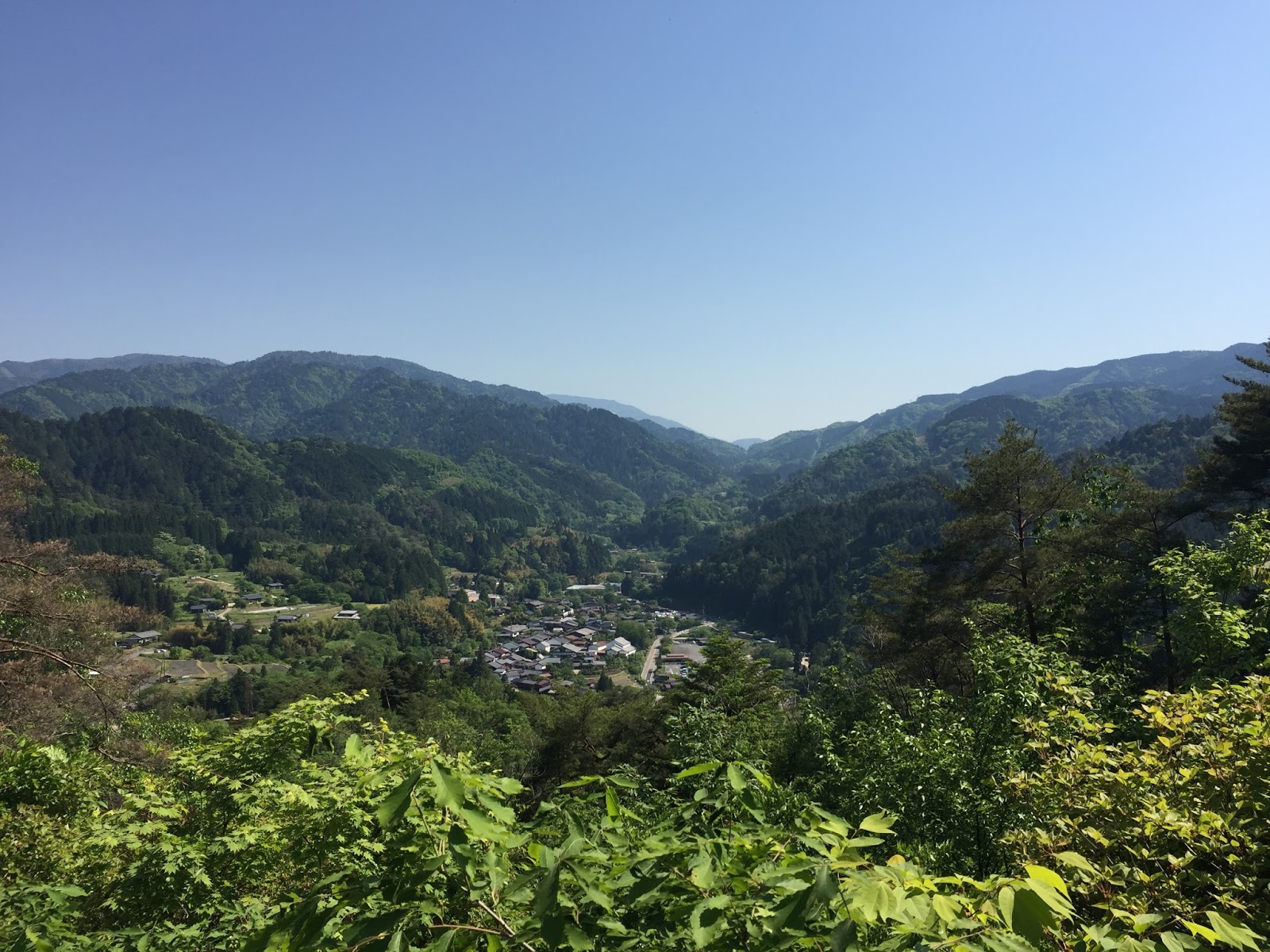
Before we reach Tsumago juku we climb yet another steep mountain path - because why not - that leads us to the ruins of Tsumago Castle. It curves through dense forest to a clearing on a mountain top where the castle used to stand. From here we can look down in to the valley and see the straight long narrow street of Tsumago in front, which is famed for it’s Edo Period authenticity, thanks to a ban on overhead wires and vending machines. The view makes it feel like an accomplishment and I stretch out my un-baggaged arms to the stratosphere. My shoulders are going to ache tomorrow but it’ll be the last day, so I’d better make the most of it. Piston helps me down the ridge and we take the final part of our route that leads us straight in to Tsumago juku. I’ve become accustomed to our solitude and so find it alien to encounter the multitude of clean tourists in town, especially anyone who looks fashionable, they’re an exotic bird to me at this point. First thing we do is grab an ice cold beer in the garden of a tea place. Yes. There’s a small dark pond with brightly coloured coy darting through it, and we sit and drink and cool off.

Walking down the street of Tsumago there are museums and souvenir shops, you can buy geta (old wooden sandals) and I overhear a shopkeeper showing off that he once killed a black bear There’s his skin, hanging right there! Our post-town experiences have all been of a similar shade but this place feels like a living museum with no town’s people living here, perhaps they run the shops and commute in. At night when we come back to walk the streets, it is dead quiet and we stumble across a few other tourists taking night time photos, and one cat. Our minshuku for the evening is located at O-Tsumago, which is an off-shoot post-town a few kilometres away, so we amble slowly through the historical settings to reach it in time for tea. The croak of the frogs in the night time, a million horns and trumpets rising out of the rice paddies, sounds like a hilarious orchestra, drowning out the sounds of the trees and rivers.

5
O-Tsumago – Magome

We stayed the night in a cheerful inn called Hanaya Ryokan, where the innkeepers had a family of their own, four or five boys and a girl. We encountered a little one in the corridor who showed us his grazed palm, and I was witness to another one’s meltdown when he found out the bath wasn’t ready. The whole family looked picturesque in the fading light of the evening playing with fireworks by the river.

After breakfast we set off in to the mountains to walk the most popular part of the Nakasendo Trail, between Tsumago and Magome juku. You pass two waterfalls on the way, the male waterfall Otaki and the female waterfall Metaki. We posed according to gender in front of those watery wonders. At some point on this trail is a tea house run by an old man dressed in a jinbei. He serves tea for guests and walkers and keeps a record of everyone who passes through and their nationality. Yesterday: 124 people. Canadian, Spanish, Australian, French, Mexican, Taiwanese, Dutch. Friday: 108 people. American, English, Brzailian, Finnish, Chinese, German. His eyes light up when I ask him about the traditional hearth he’s prepared, and why there’s always a model of fish hanging on top of iron kettles? The fish is a water creature and the kettle is of fire, so the fish will work to keep the fire below its line to protect the rest of the house from catching fire. He chops wood blocks with an axe and serves us tea. The phone rings and a fire announcement for the mountains crackles over the loudspeaker. We bow and place some coins in the donation box to get on our way to Magome, but afterwards I’m still thinking about what he said, in the few moments of dark quiet we stole in the smokey shade of his world. In that old museum piece of a Japanese house on the Nakasendo. He is interested in telling people about the original walkers of the Nakasendo, commoners who had to carry loads, run to feed families, sell wares to make money. They stopped along the way at havens like the place he’s housekeeping, slurping noodles, drinking water, sharing stories. Today he is the only volunteer working 360 days a year to keep that place running - I get five days off for New Year.


We pass a famous twinned cypress tree; two trees that grew in to one. And for the final memorable time on our hike we pass a group of stone jizo, or saints marking the way. I have loved how the sunlight dapples the forest floor and the sheer amount of green I have grown used to seeing every day. The path leads us out of the mountains and onto a road that winds steadily downwards towards Magome juku. There’s a viewpoint from where we can see several mountains under the searing sun, and it feels like we’ve done something. Magome is another touristic post-town, not too dissimilar from Tsumago, hence maybe why they’re linked together in the guidebooks. There’s a general hustle and bustle but because it’s 28 degrees and rising, everyone is melting (or maybe only me) so we duck in to a soba shop and order noodles and beer. We’ve got a bus to catch out of the mountains back in to the city of Nagano, then a bullet train to hurtle us back towards Tokyo, undoing all the beautiful labour of the last five days. And we’re happy.